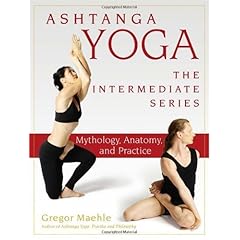
 a whole lot. I had liked his first book
 too and even wrote a review on it, but it must have been in my old blog, which unfortunately no longer exists.
In true 8 limb form, these are the 8 things I can say surprised me and delighted me about it, here they are:
1 - Dedication/Acknowledgments
The first thing that called my attention in a big way is the dedication to "Mother India", and his acknowledgment to the "modern master of Ashtanga Vinyasa Yoga Shri T. Krishnamacharya and those who studied under him and continue his work". He also thanks his wife, nice. However, back to the first sentence, do you see something missing? I certainly did, the no mention of Patthabi Jois was new. I don't remember if he mentioned him on the first book, (he does not, he also thanks all teachers) but it made me wonder. It certainly puts the whole Ashtanga Vinyasa Yoga concept in a new light.
2 - The Amazing Visuals along the 8 limbs path description
I have never heard a teacher or read such a vivid and clear description of the journey through the 8 limbs (branches) before reading his first chapter. After guiding us through how is it that Karma Yoga (yoga of action) is the type we are practicing, he embarks on a voyage of what actually happens as we travel through the yamas, niyamas, and so on. And he gets down to the very specifics of it, no second guesses about it.
For example, his description of what is it exactly that one does while on Dharana (concentration):
"Practically, dharana is done in the following way you assume Padmasana ... and commence pranayama until breath retention (kumbhaka) is reached. Once in kumbhaka you rest the mind on your chosen location, beginning with the base chakra..."Or what actually may happen when reaching Dyana (Meditation):
"The fascinating opening that happens when you get to this stage [Dhyana, Meditation, page 11] is that you can "download" or "log on" to the Deva, or Divine form, that resides in or presides over each respecctive chakra."I have to say that it left me wondering weather he speaks from personal experience or from the vast amount of studying he has done. So I asked him that, via e-mail, I hope he replies (he did not).
3 - His case for using Indian myth to deepen the practice in chapter 2
"In the course of this discusion I show how the study of myth can change the way you practice yoga and live your life..... you can create your own private hotline to and from the Supreme Being"4 - His convincing case for why studying Sanskrit is important for us on the path.
He uses the story of how Krishnamutri dedicated his latest days (he was 95 and was not able to do so before because of selfless service, of course!) to learn Sanskrit.
He goes on to have a side note on English vs Sanskrit and then invites the reader to go back to the original texts rather than current yoga texts, and to make our own conclusions of what the sages were trying to say. He also gives warnings about them attacking other schools or reading things always within contexts since, it seems the old sages had a trickster side to them, just for the benefit of the students.
5- The Mythology of the poses of the intermediate series had me going.
Especially his interpretation of Pashasana as an asking to Lord Shiva for a "boon". I think anyone can relate to this process of waiting for a teacher to grant us the passage into intermediate, however, seen in this new light I somehow relate to the imagery of it, and wonder weather I could ask Shiva directly. He goes on to clarify that the REAL boon we are asking for is not just pashasana (which would be nice), but rather the understanding of immortality. Of course, it is all always much deeper.
6 - The actual mythology behind every pose is a must read
I particularly liked the few stories around Kapottasana, out of them this one was cute:
"The Skanda Purana informs us how Lord Shiva received the name Kapota. He once undertook severe tapas in the form of living only on air and avoiding all pairs of opposites. Although he was the master of the eight forms (five elements, moon, sun, and Lord) he shrank to the size of a pigeon. Henceforth, he was known to his devotees by the name of Kapota"How is that shrinking to pigeon image next time you are warming up to the idea of Kapo?
7 - His standing up for the antiquity of Ashtanga Vinyasa Yoga was reassuring.
Not so much on the other hand, the idea that we are actually loosing asanas.
8 - The poses
Just like in the first book, the actual asanas have great pictures with detailed vinyasa explanations and anatomy charts. There are also tips spread out throughout in orange squares just as he had on the former.
---
A book like this leaves me more interested in the inner path of yoga, in its depth, in the possibilities. It makes me want to feel whatever samadhi is, to understand how can one actually surrender to such an extent and reminds me that reading the sacred texts is of vital importance.
Karma yoga, he says, is for those of us who are not ready to give up the "what's in it for me" part of life, that is why we are not ready for Bhakti (devotion), which requires it, and not even close to near the Jnana yoga (Intellectual yoga), which is only for a few geniuses.
As per me, I am happy to be brought closer to the feeling of what is important after all, drop back or not. that is not to say I am abandoning my intentions though, my new year resolution still holds... I might as well make full use of the fact that I am a karma yogi.
Have you read it? what do you think?
No comments:
Post a Comment
Note: Only a member of this blog may post a comment.