Sharath's little boy seemed pretty curious about my notebook, he took it from me and said "notebook", to which his sister replied something in Hindi I did not get. He is way too cute! Later as the students were coming in Pratak had him in his arms, and he kept asking each student: "What is your name?"
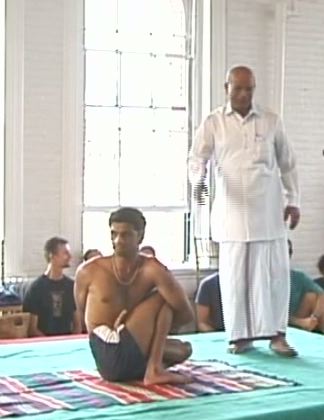 Sharath opened the conference talking about drishtis (or eye focus points for each of the poses), apparently some students had been asking him about it. So he listed all of them and talked how they help in bringing about concentration.
He also discussed the importance of sticking to the technique explained in the shastras (scriptures), in the proper way, to respect the tradition and the teachings of the lineage. He used the example of "pujas" or Indian ways of praying to God and how they have a specific format and practice and that our practice, says Sharath, is just like it, it has its system. (picture from this website)
He joked about how in churches in the West we seem to stand up and sit down a lot which caused laughter, and compared those rituals to the Indian ones, only, well, theirs are different.
He used Pattabhi Jois again as an example of dedication to a system, and how he used to drive every day to the old shala at 4:15 in the morning and then again in the afternoon, and how he would say what we have all heard many times, that anyone can take yoga, young, old, very old, sick, someone with no strenght, they can all take yoga, the only person that cannot take yoga is... and about half of the 250 of us responded "lazy".
Seems that at some point someone who was 93 years old came to him because a doctor wanted to operate on him from Hernia, but instead this man decided to go to Jois and take up yoga. Seems he did not last very long, but at least he tried. The story faded into the background and we did not get a resolution on it.
Then he focused on drishti again and elaborated on how our minds get distracted, how we are thinking about our wife or girlfriend when we should be focused on the practice, and how the focus point helps in bringing us back into the practice, into the moment, into deepening our asana, and into making the practice better.
"To cook a good soup you need all the ingredients", and so the breath is like the "masala", the drishti is one of the spices and so is asana. Someone asked about bandha, and the answer came back that it is part of the asana, and also of daily living. He mentioned that Guruji used to say that mula bandha should be engaged at all times.
An interesting question came from a student asking if it is necessary to believe in God to practice Ashtanga. Yes! said Sharat, it does not matter what God you believe in because God is one, but faith is necessary. Then he told another joke:
Three men fall into a well of water, a muslim, a christian and a hindu. The Muslin says "Ala, please help me!", the Christian says: "Jesus, please help me!", and the Hindu says: "Shiva, Krishna, Lakshimi, Ganesh... Hanuman, please save me!", only the Gods turn to each other, Shiva says to Krishna: you save him!, and then Krishna turns to Lakshimi and says: no, you save him! and on and on it goes. Too many Gods!
I was happy to hear on another note and in his last announcement that they are aware of the mischiefs happenings in Gokulam, students were advised to walk in clusters especially for the early morning class. Good thing, perhaps the police commissioner already knows.
Conference was only half an hour because a man named Govinda came in with his entourage and some beautiful northern Indian instruments and they played music.
The afternoon faded into smoothies at Ganesh in good company and a game of "Banana Scrabble". Gosh I love those smoothies, I had one and a half.
My game of banana-scrabble definitely needs a LOT of help.
The Drishtis of the practice, or focus points are:
Asagrai - Tip of the nose
Nabi Chakra - The navel
Hastagrai - The hand
Padayorgrai - The toes
Angusta Ma Dyai - The thumbs
Urdhva / Antara Drishti - Up to the sky
Parsva - Far to the right or to the left
Ajna Chakra / Broomadhya - The third eye
He also discussed the importance of sticking to the technique explained in the shastras (scriptures), in the proper way, to respect the tradition and the teachings of the lineage. He used the example of "pujas" or Indian ways of praying to God and how they have a specific format and practice and that our practice, says Sharath, is just like it, it has its system. (picture from this website)
He joked about how in churches in the West we seem to stand up and sit down a lot which caused laughter, and compared those rituals to the Indian ones, only, well, theirs are different.
He used Pattabhi Jois again as an example of dedication to a system, and how he used to drive every day to the old shala at 4:15 in the morning and then again in the afternoon, and how he would say what we have all heard many times, that anyone can take yoga, young, old, very old, sick, someone with no strenght, they can all take yoga, the only person that cannot take yoga is... and about half of the 250 of us responded "lazy".
Seems that at some point someone who was 93 years old came to him because a doctor wanted to operate on him from Hernia, but instead this man decided to go to Jois and take up yoga. Seems he did not last very long, but at least he tried. The story faded into the background and we did not get a resolution on it.
Then he focused on drishti again and elaborated on how our minds get distracted, how we are thinking about our wife or girlfriend when we should be focused on the practice, and how the focus point helps in bringing us back into the practice, into the moment, into deepening our asana, and into making the practice better.
"To cook a good soup you need all the ingredients", and so the breath is like the "masala", the drishti is one of the spices and so is asana. Someone asked about bandha, and the answer came back that it is part of the asana, and also of daily living. He mentioned that Guruji used to say that mula bandha should be engaged at all times.
An interesting question came from a student asking if it is necessary to believe in God to practice Ashtanga. Yes! said Sharat, it does not matter what God you believe in because God is one, but faith is necessary. Then he told another joke:
Three men fall into a well of water, a muslim, a christian and a hindu. The Muslin says "Ala, please help me!", the Christian says: "Jesus, please help me!", and the Hindu says: "Shiva, Krishna, Lakshimi, Ganesh... Hanuman, please save me!", only the Gods turn to each other, Shiva says to Krishna: you save him!, and then Krishna turns to Lakshimi and says: no, you save him! and on and on it goes. Too many Gods!
I was happy to hear on another note and in his last announcement that they are aware of the mischiefs happenings in Gokulam, students were advised to walk in clusters especially for the early morning class. Good thing, perhaps the police commissioner already knows.
Conference was only half an hour because a man named Govinda came in with his entourage and some beautiful northern Indian instruments and they played music.
The afternoon faded into smoothies at Ganesh in good company and a game of "Banana Scrabble". Gosh I love those smoothies, I had one and a half.
My game of banana-scrabble definitely needs a LOT of help.
The Drishtis of the practice, or focus points are:
Asagrai - Tip of the nose
Nabi Chakra - The navel
Hastagrai - The hand
Padayorgrai - The toes
Angusta Ma Dyai - The thumbs
Urdhva / Antara Drishti - Up to the sky
Parsva - Far to the right or to the left
Ajna Chakra / Broomadhya - The third eye
Too funny about mula bandha. Chris said recently that it'd be nice to turn it on in the morning when you get up & flick it off light a light switch when you go to sleep but, "I don't know anybody who does that." Course Sharath was talking just about during asana I am sure!
ReplyDeleteNo, he was saying EXACTLY what Christopher said... ALL DAY LONG...
ReplyDeleteFunny he said it at the same time... they are connected Chris and Sharath!
Really??? All damned day? This was at C's workshop on the 22nd, but I suppose it must be a Guruji thing.
ReplyDeleteYes it is... and yes, I know, all day!!! it's a bit like: WOW!
ReplyDeleteThanks for this. I didn't really get the importance/usefulness of drishti until I tried a home practice. I am so much more easily distracted when there are no teachers calling the next move! It's odd that having others practicing around me is less distracting than practicing at home with no moving objects around other than myself!
ReplyDeleteRegarding mula bandha, some people have very weak core and they walk around with a slouch or with their gut hanging out. It's bad for posture and makes the body prone to injury. I think of it as gently engaging our core muscles just enough so we have good postures and basic protection for our spine.
ReplyDeleteYYogini, I agree with you on both comments, I also have half a home practice and drishti does make a HUGE difference... as per mula bandha, yeap, wish more people would be aware of it...
ReplyDeleteI remember the first time I was introduced the concept of dristhi. it was at Sivananda Yoga Center in NYC...and from the first moment I loved this practice. There is something so unifying about the drishti...it really does quiet the mind. I love it in my own practice and in my teaching. Thank you for sharing, Claudia. I was unaware of the names each of these drishti points have.
ReplyDelete