Ironically my journey into Yoga Therapy begins with case number ONE filed under: Myself. I have Lyme disease, and I am studying it just as I feel it, just as I loose all energy and need to lay in bed and only write or think when I get 'windows' of energy.
Not only that, I am using yoga or not using it when it is impossible to use. I know my case will not be valuable information for everyone, but I also know that some of it will be. Nothing is clear cut, black or white, such is life.
This disease, what I am going through, is how I believe, we, organically, and in a real way, become yogis that venture into the field of therapy. Perhaps just by being thrown directly into it by sickness, or maybe by feeling a strong call to the vocation.
I am also very clear that we will never be doctors, chiropractors, acupuncturists, psychologists, MSW, internists, oncologists, etc... Keeping it real and knowing our limitations, i.e.: where our knowledge ends, is critical.
Following my post from yesterday I have a new proposition on how to look at Yoga Therapy that yes, of course includes continuing education, just like with yoga, and preferably one that comes from the highest sources, from those that studied yoga with Krishnamacharya himself, but also patience, research, keeping journals, networking, building a team.
Sutra 3.36 is my mantra as I thread this new territory. Discriminating what is real from what is not and understanding our own limitations is the very foundation of being a yoga teacher of integrity. And that includes noticing when and if my own arrogance is taking the best out of me.
The title of Yoga Teraphist needs to be EARNED, not to paid for. Paying is cheap, anyone can pay after saving for some time. There is nothing inherently wrong with taking courses and paying for them, but even after, just with a degree or certification, it means nothing in the field of healing.
This is a 32 Step path I propose as an alternative to regulation that results in expensive module- classes leading to certifications, or worst, institutionalized college degrees that follow government regulations and drain prospective talented students of all moneys they may have saved to actually start practicing by using their talent.
Thw path I propose follows lineage, and involves slow-building, solid work, cooperation, and much reflection throughout years and years of dedicated practice.
1.- Vision and Foundation
Recognize that the field of Yoga Therapy requires a healthy, balanced, centered yoga teacher with a strong personal daily practice and deep understanding of yoga principles. Embarking on such a new venture without a solid foundation is not advisable and frankly un-realistic.
On the vision front, having one is mandatory, not optional. Given that Yoga Therapy is a new and exciting field, being clear as of where we want to be is not only necessary, is vital for the success of our endeavours. And yes, by vision I do mean vision boards, charts, papers that outline where we see ourselves in a year, two, five, twenty-five.
Knowing where we want to go (what kind of practice we want, where to practice, the type of cases we would like to attract, what type of work with would like to use Yoga Therapy on, what kind of monetary reward we would like to obtain, what kind of a professional community we would like to create, etc) has the power of giving us direction as we take each step along the way.
I highly recommend reading this book (left: "Building Your Ideal Private Practice") which includes not just tips for theraphists but for anyone who is seriously and committed to serve in the world through a private practice.
In this case that would be through yoga, be it just by teaching or by extending into therapy.
2.-Having an Integral Vision of each Student
Have a willingness to treat students as individuals with whole lives. Get involved, get in there, learn about them, know what they need.
Yes, this goes beyond a regular yoga teaching requirement, but then again, not everyone will have the call to the vocation of Yoga Therapy. If you do, then getting involved, softly and in a respectful manner is important.
4.-Patience
Be prepared to be patient and know that a practice of yoga therapy, just as the one of yoga is for a life time
5.-Build a wide network of professionals
that you, the yoga teacher/therapists, knows personally, has regular meetings with, and can refer students to. This can be accomplished by following these suggested steps:
I can see in her connection with nature in the dream how she draws on her own intuition to continue on. I believe Yoga Therapy bridges the scientific male-dominated field of medicine with the intuitive feminine.
For us yogis, being in touch with the unconscious and paying attention to the direction of our dreams as well as of life as symbolism is a gift. Even though running reality checks always stands as an important step, trusting our own intuition must be an important part of our practice.
25.- Being able to let go
If you are a woman then I am sure this happened to you at least once: You say something in a meeting and then another person (often a man) says the same thing. He gets recognition, you do not.
We must be able to trust that these situations are as they are. To clarify: we may think that we KNOW that not drinking coffee is THE thing that will help someone heal, but if the receiver is not ready to receive such message we must give up the results, trust that there is a divine healing plan for each person, trust their own healing process and allow them the opportunity to listen when they are ready. Of course this has nothing to do with male or female, but it is the case that people sometimes only want to hear certain things from certain people.
The Divine always has a way to let whoever is ready to listen hear a message. She will send different messangers until one hits the listening spot. Trusting the forces of Divine Intervention IS YOGA.
There is another side to this too, the side where intervertion might be inminent. For example, in the HBO show "In Treatment", Paul, the psychiatrist, finds himself in front of a young woman with cancer who refuses to tell anyone that she is sick. The show leads us to believe that for her chemotherapy is the only option at the late stage she is on.
Given these circumstances, Paul does everything in his power and even gets in the patients face. Furthermore he even goes as far as breaking some rules by taking her to chemotherapy himself on her first session. Of course he does that after running a reality check by his own theraphist.
I am not advocating breaking rules, but I am advocating discrimination, being grounded and putting the student/client/patient first, and our egos aside.
26.- Keeping in check the attitude of 'Holier than thou':
I have seen examples in the blog sphere where people are abrasive, casting shadows on other's work, dismissing it negatively, making it all look very bad. This happens maybe via Facebook or Twitter or in boards.
We need to understand that the only way for communication to happen is to feel this anger we have before we make this remarks, connect with our Divine inspiration and ask for answers, tracet the anger, notice where it may be coming from, let it breath, pay attention and after consideration, deciding on what would be the best course of action, which in some cases (if not all) would very well be to just shut up.
27.- The Imminent Necessity to go Beyond our Desires and Wishes
When it comes to people wanting to heal, our wishes and desires need to be set aside. A strong grounding and an ability to remain open to what is actually happening must take precedent. Always. Being clear is the only path to the best recommendations and suggestions. We are not Gods, we have no power to heal, we can only get out of our own ways, and pray to be channels of lights. Let us be clear on that, the sooner the better.
28.-Our own practice as metaphor
Every time I get into the back bends I realize that I go further into the pose and understand it more, or learn new things about it just by doing it. It is in the doing that the learning happens.
29.- Being Firm, Having the Guts
In order to say to someone something that they may not want to hear, there is a need for tremendous clarification, support from others on how to phrase and present things, thinking, reflection, putting it in the light, asking Divine Mother for help. Then, when in conversation, strength compassion, and clarity are necessary. Say what has to be said, ensure you prepared beforehand.
30.-Don't enter the psychic of another when uninvited
Right before her death, Radha advised her own group of trusted teachers:
The advise was given over teaching, but I think it permeates a lot more than that. If we are not helping a person find her own way, if we are imposing our own, how can healing or understanding ever happen?
31.- What Pattabhi Jois so succintly said about practice applies here too: do your practice and all is coming
32.- Never Rush!
Put quality ahead of quantity and speed. If one area needs patience, space, and quality is healing.
-----
Not only that, I am using yoga or not using it when it is impossible to use. I know my case will not be valuable information for everyone, but I also know that some of it will be. Nothing is clear cut, black or white, such is life.
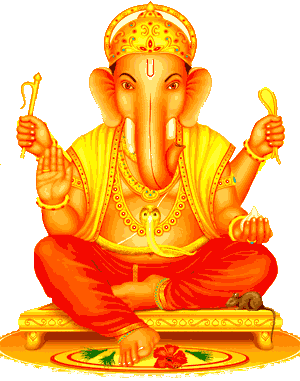 |
| May Ganesh remove obstacles so we can be dedicated, grounded, true professionals, and channel the Divine |
I am also very clear that we will never be doctors, chiropractors, acupuncturists, psychologists, MSW, internists, oncologists, etc... Keeping it real and knowing our limitations, i.e.: where our knowledge ends, is critical.
Following my post from yesterday I have a new proposition on how to look at Yoga Therapy that yes, of course includes continuing education, just like with yoga, and preferably one that comes from the highest sources, from those that studied yoga with Krishnamacharya himself, but also patience, research, keeping journals, networking, building a team.
Sutra 3.36 is my mantra as I thread this new territory. Discriminating what is real from what is not and understanding our own limitations is the very foundation of being a yoga teacher of integrity. And that includes noticing when and if my own arrogance is taking the best out of me.
The title of Yoga Teraphist needs to be EARNED, not to paid for. Paying is cheap, anyone can pay after saving for some time. There is nothing inherently wrong with taking courses and paying for them, but even after, just with a degree or certification, it means nothing in the field of healing.
Healing is a gift and as such it must be earned.
This is a 32 Step path I propose as an alternative to regulation that results in expensive module- classes leading to certifications, or worst, institutionalized college degrees that follow government regulations and drain prospective talented students of all moneys they may have saved to actually start practicing by using their talent.
Thw path I propose follows lineage, and involves slow-building, solid work, cooperation, and much reflection throughout years and years of dedicated practice.
1.- Vision and Foundation
Recognize that the field of Yoga Therapy requires a healthy, balanced, centered yoga teacher with a strong personal daily practice and deep understanding of yoga principles. Embarking on such a new venture without a solid foundation is not advisable and frankly un-realistic.
On the vision front, having one is mandatory, not optional. Given that Yoga Therapy is a new and exciting field, being clear as of where we want to be is not only necessary, is vital for the success of our endeavours. And yes, by vision I do mean vision boards, charts, papers that outline where we see ourselves in a year, two, five, twenty-five.
Knowing where we want to go (what kind of practice we want, where to practice, the type of cases we would like to attract, what type of work with would like to use Yoga Therapy on, what kind of monetary reward we would like to obtain, what kind of a professional community we would like to create, etc) has the power of giving us direction as we take each step along the way.
I highly recommend reading this book (left: "Building Your Ideal Private Practice") which includes not just tips for theraphists but for anyone who is seriously and committed to serve in the world through a private practice.
In this case that would be through yoga, be it just by teaching or by extending into therapy.
2.-Having an Integral Vision of each Student
Have a willingness to treat students as individuals with whole lives. Get involved, get in there, learn about them, know what they need.
Yes, this goes beyond a regular yoga teaching requirement, but then again, not everyone will have the call to the vocation of Yoga Therapy. If you do, then getting involved, softly and in a respectful manner is important.
3.-Have strong and clear professional boundaries.
You can go through the exercises outlined in the wonderful book "Teaching Yoga" just to test yourself and see how close to center you are or how off when it comes to dealing with difficult situations among teachers and students or teaches and patients (or would they be called clients?, I mean, in Yoga Theraphy?)
In a recent post in which I reviewed the book (which I coined: "The book that every student and teacher of yoga MUST read") you can get a taste for the difficult situations that can present themselves with clear and solid suggestions as of how to deal with them as well as cases that leave you reflecting and thinking. Cases that pose a difficult position yet give no answers. Wonderful exercises!
I find these to be exercises that cannot be hidden under a carpet, they need to be processed, discussed in groups, explored, analyzed.
4.-Patience
Be prepared to be patient and know that a practice of yoga therapy, just as the one of yoga is for a life time
5.-Build a wide network of professionals
that you, the yoga teacher/therapists, knows personally, has regular meetings with, and can refer students to. This can be accomplished by following these suggested steps:
- Get a notebook and fill the top of each page with the title of all professions that can help in the treatment of a yoga student (psychologist, psychiatrist, general medicine practitioner, internist, OBGYN, specialists in every area of medicine, counselors, etc, and then also alternative forms i.e.: massage therapy (different styles), acupuncture, reiki, aromatherapy, other yoga styles, and so on.
- Network in the community of your residence, for example creating a monthly meeting of professionals to discuss and share notes and referrals.
- No names of students or patients/clients are ever named, the privacy of their identity is always respected, but the lessons learned can be shared.
- Maintain professional relationships with every different person you know in each of their fields, keep updated, make an effort to stay in touch
- Become a cool person, don't speak badly behind anyone's backs, make integrity and peace your center. This will allow you to have better and more interactions, to learn more, everyone will beneft,
- Make the meetings interesting, bring in cases, either current situations you are dealing with at the moment or something you read. Propose questions, engage conversation.
- Place in the notebook, under each category, only the professionals that you know in your heart to be the best in the field
- Recommend them
- This will create a community where all professionals benefit, recommend each other for good services and thrive while having happy, healed and satisfied students/patients/clients.
 |
| Patiently build a network |
6.-Reaching Further
Extend this local network into a national network and eventually an international one. In time, of course.
7.-Continue your own education. Owning your Commitment to Education.
Do so with the best teachers in the field, the closest to Krishnamacharya the better, and also researching who are in the frontier of Yoga Therapy today, as we move away from the generation of Krishnamacharya and his teachers which, luckily for us, is not to happen for a while, but there will be new great Therapists emerging, keep them in mind, learn from them, meet them, network, share your cases, give somethng for free, keep them in high esteem. Develop relationships.
Do so with the best teachers in the field, the closest to Krishnamacharya the better, and also researching who are in the frontier of Yoga Therapy today, as we move away from the generation of Krishnamacharya and his teachers which, luckily for us, is not to happen for a while, but there will be new great Therapists emerging, keep them in mind, learn from them, meet them, network, share your cases, give somethng for free, keep them in high esteem. Develop relationships.
8.-Reading, Studying, Going to Conferences
Keep informed of developments in the field, attend conferences, discuss cases, situations. Who healed? how? why?
At the moment there are several organizations that publish and are interested in Yoga Therapy cases, and on the effects of yoga in healing. They are a good place to start and follow:
Keep informed of developments in the field, attend conferences, discuss cases, situations. Who healed? how? why?
At the moment there are several organizations that publish and are interested in Yoga Therapy cases, and on the effects of yoga in healing. They are a good place to start and follow:
- International Association of Yoga Teraphy
- Yoga Therapy London
- Kaivalyadhama Institute in India, doing research on healing through yoga for a very long time.
- Kripalu Institute for Yoga Research
- A.G. Mohan (A direct student of Krishnamacharya) course of Yoga Therapy. Link is not working right now, but try in a while: www.svastha.com/
- Ramaswami's Page (a student of Krishnamacharya for 35+years)
9.-Sharing Leanings
Write about your findings, keep a journal for private notes and share important findings with colleagues, in journals, wide-reaching blogs, newspapers, field magazines, or personal blogs
Write about your findings, keep a journal for private notes and share important findings with colleagues, in journals, wide-reaching blogs, newspapers, field magazines, or personal blogs
10.-Records
Maintain a flawless records of all interactions, recommendations, details, progress, and a description of what happened.
Maintain a flawless records of all interactions, recommendations, details, progress, and a description of what happened.
11.-De-Briefing
Take time for taking inventory. What was done correctly? What could be improved in the future?
Take time for taking inventory. What was done correctly? What could be improved in the future?
12.-Keeping the Yogi Healthy and the personal practice thriving
Ensure that your own yoga practice is well tended to, as well as your spirit, and emotional being. We need to make sure that we are coming from a position of presence, power, peace, discrimination.
Ensure that your own yoga practice is well tended to, as well as your spirit, and emotional being. We need to make sure that we are coming from a position of presence, power, peace, discrimination.
13.-Volunteering to Both Build the Practice and Learn
In the beginning it might help to volunteer in hospitals, hospices, prisons, and learn about a wider audience and what their needs might be, understand how yoga is perceived, how it can heal and how it cannot.
In the beginning it might help to volunteer in hospitals, hospices, prisons, and learn about a wider audience and what their needs might be, understand how yoga is perceived, how it can heal and how it cannot.
14.-Listen, listen and listen again.
When talking to students make sure that we are understanding exactly what it is that is being said. Neve fear looking foolish for clarifying. Listening is the art that a yoga teacher needs the most.
"Yoga beigins with listening" Richard Freeman
When talking to students make sure that we are understanding exactly what it is that is being said. Neve fear looking foolish for clarifying. Listening is the art that a yoga teacher needs the most.
"Yoga beigins with listening" Richard Freeman
15.-Keen observation while teaching classes
A dedication to the best standards of quality and professionalism. Noticing things in students yet not interfering unless approached. Not feeling like we are the ones knowing it all, because we are not.
A dedication to the best standards of quality and professionalism. Noticing things in students yet not interfering unless approached. Not feeling like we are the ones knowing it all, because we are not.
16.-Dressing the Part
Ensuring we use proper and adequate dress and presentation in every class and professional interaction. Adequate, elegant (not necessarily expensive) dressing and grooming sends a message of professionalism, invites trust. Trust in turn invites opening and conversations.
Ensuring we use proper and adequate dress and presentation in every class and professional interaction. Adequate, elegant (not necessarily expensive) dressing and grooming sends a message of professionalism, invites trust. Trust in turn invites opening and conversations.
17.-Remember it is a Practice
Keeping in mind that it is a practice, a journey. That cases as well as relationships will build up, more people will be met and the knowledge / experience will grow. Never take anything for granted. Always assume a humble attitude
Keeping in mind that it is a practice, a journey. That cases as well as relationships will build up, more people will be met and the knowledge / experience will grow. Never take anything for granted. Always assume a humble attitude
18.-Praying
Praying in any form you understand to the forces of nature to give us the miracle to look at things as they are without the filter of how we would like them to be. Always. Daily.
Praying in any form you understand to the forces of nature to give us the miracle to look at things as they are without the filter of how we would like them to be. Always. Daily.
19.- Real Presence in Honoring the Relationship to the Student
Honoring the student teacher relationship, making safety and respect a priority. Being present for what is happening.
This reminds me of a story told in the book "A New Earth ", in which Eckhart Tolle was in his apartment when suddenly one night a neighbour knocked loudly at his door at 11 PM. She stormed in after he opened the door and spread papers on the floor, bills, court summons etc. She was in a state of panic, repeating that she would not be able to cope with it, that it was her end, that she would have to sell everything, go bankrupt. Tolle looked at her with full attention, not judging, not offering opinions, not adding to the fire. He just gave her space to have her moment, to feel her feelings.
After a few minutes she stopped, looked at him and said: this is not important at all isn't it? He just nodded no. She picked her papers up, went back to her place and confessed the next morning to have had the best night sleep ever.
Honoring the student teacher relationship, making safety and respect a priority. Being present for what is happening.
This reminds me of a story told in the book "A New Earth
", in which Eckhart Tolle was in his apartment when suddenly one night a neighbour knocked loudly at his door at 11 PM. She stormed in after he opened the door and spread papers on the floor, bills, court summons etc. She was in a state of panic, repeating that she would not be able to cope with it, that it was her end, that she would have to sell everything, go bankrupt. Tolle looked at her with full attention, not judging, not offering opinions, not adding to the fire. He just gave her space to have her moment, to feel her feelings.After a few minutes she stopped, looked at him and said: this is not important at all isn't it? He just nodded no. She picked her papers up, went back to her place and confessed the next morning to have had the best night sleep ever.
20.- Stay Grounded
For example having a friend or college by whom we can "check in" or "run a reality check" by. Being aware of ego. When we are not sure if it is Divine Power or our ego talking, then, stopping and running things by another professional. Always.
For example having a friend or college by whom we can "check in" or "run a reality check" by. Being aware of ego. When we are not sure if it is Divine Power or our ego talking, then, stopping and running things by another professional. Always.
21.-Embracing Life, Embracing Death
Accepting that not all cases have cures even with the best referrals, with the best doctors, even with the best of everything, life is a cycle. Death is another. God bless them both.
Accepting that not all cases have cures even with the best referrals, with the best doctors, even with the best of everything, life is a cycle. Death is another. God bless them both.
22.-Exploring our own Emotional Body
Exploring our own concept of death, getting clear on how we see it and talking with other professionals teachers, friends to clarify our own feelings before we can be a beacon of support for those who may be dying, for example in the case of terminal diseases.
Exploring our own concept of death, getting clear on how we see it and talking with other professionals teachers, friends to clarify our own feelings before we can be a beacon of support for those who may be dying, for example in the case of terminal diseases.
23.- Rain Making and Clear Guidelines
If the practice has a good foundation the cases will appear. By then it is important to have detailed written guidelines as of how the therapy operates, what does it mean, how does it happen, what are the boundaries, how are the sessions conducted, what are the costs, who are the professionals in the network. Aiming for full transparency.
24.- Connecting with the underworld.
In her wonderful book, Carried by a Promise , Swami Radhananada, the successor of Radha and current president at the Yasodhara Ashram in British Columbia, talks about her work with dreams. One of them, which she describes, includes her meeting someone named: Lady Able, she says:
"Lady Able tells me she comes from the greenness of the trees, the bushes, grass, moss and has a pleasant peaceful living growing with positive ideas... she is always growing and doing things but her energy is directed and powerful"
If the practice has a good foundation the cases will appear. By then it is important to have detailed written guidelines as of how the therapy operates, what does it mean, how does it happen, what are the boundaries, how are the sessions conducted, what are the costs, who are the professionals in the network. Aiming for full transparency.
24.- Connecting with the underworld.
In her wonderful book, Carried by a Promise
, Swami Radhananada, the successor of Radha and current president at the Yasodhara Ashram in British Columbia, talks about her work with dreams. One of them, which she describes, includes her meeting someone named: Lady Able, she says:"Lady Able tells me she comes from the greenness of the trees, the bushes, grass, moss and has a pleasant peaceful living growing with positive ideas... she is always growing and doing things but her energy is directed and powerful"
I can see in her connection with nature in the dream how she draws on her own intuition to continue on. I believe Yoga Therapy bridges the scientific male-dominated field of medicine with the intuitive feminine.
For us yogis, being in touch with the unconscious and paying attention to the direction of our dreams as well as of life as symbolism is a gift. Even though running reality checks always stands as an important step, trusting our own intuition must be an important part of our practice.
25.- Being able to let go
If you are a woman then I am sure this happened to you at least once: You say something in a meeting and then another person (often a man) says the same thing. He gets recognition, you do not.
We must be able to trust that these situations are as they are. To clarify: we may think that we KNOW that not drinking coffee is THE thing that will help someone heal, but if the receiver is not ready to receive such message we must give up the results, trust that there is a divine healing plan for each person, trust their own healing process and allow them the opportunity to listen when they are ready. Of course this has nothing to do with male or female, but it is the case that people sometimes only want to hear certain things from certain people.
The Divine always has a way to let whoever is ready to listen hear a message. She will send different messangers until one hits the listening spot. Trusting the forces of Divine Intervention IS YOGA.
There is another side to this too, the side where intervertion might be inminent. For example, in the HBO show "In Treatment", Paul, the psychiatrist, finds himself in front of a young woman with cancer who refuses to tell anyone that she is sick. The show leads us to believe that for her chemotherapy is the only option at the late stage she is on.
Given these circumstances, Paul does everything in his power and even gets in the patients face. Furthermore he even goes as far as breaking some rules by taking her to chemotherapy himself on her first session. Of course he does that after running a reality check by his own theraphist.
I am not advocating breaking rules, but I am advocating discrimination, being grounded and putting the student/client/patient first, and our egos aside.
26.- Keeping in check the attitude of 'Holier than thou':
I have seen examples in the blog sphere where people are abrasive, casting shadows on other's work, dismissing it negatively, making it all look very bad. This happens maybe via Facebook or Twitter or in boards.
We need to understand that the only way for communication to happen is to feel this anger we have before we make this remarks, connect with our Divine inspiration and ask for answers, tracet the anger, notice where it may be coming from, let it breath, pay attention and after consideration, deciding on what would be the best course of action, which in some cases (if not all) would very well be to just shut up.
27.- The Imminent Necessity to go Beyond our Desires and Wishes
When it comes to people wanting to heal, our wishes and desires need to be set aside. A strong grounding and an ability to remain open to what is actually happening must take precedent. Always. Being clear is the only path to the best recommendations and suggestions. We are not Gods, we have no power to heal, we can only get out of our own ways, and pray to be channels of lights. Let us be clear on that, the sooner the better.
28.-Our own practice as metaphor
Every time I get into the back bends I realize that I go further into the pose and understand it more, or learn new things about it just by doing it. It is in the doing that the learning happens.
29.- Being Firm, Having the Guts
In order to say to someone something that they may not want to hear, there is a need for tremendous clarification, support from others on how to phrase and present things, thinking, reflection, putting it in the light, asking Divine Mother for help. Then, when in conversation, strength compassion, and clarity are necessary. Say what has to be said, ensure you prepared beforehand.
30.-Don't enter the psychic of another when uninvited
Right before her death, Radha advised her own group of trusted teachers:
"Don't enter the psychic of another with your insight. Keep it to yourself. Just ask questions and observe what comes back"
The advise was given over teaching, but I think it permeates a lot more than that. If we are not helping a person find her own way, if we are imposing our own, how can healing or understanding ever happen?
31.- What Pattabhi Jois so succintly said about practice applies here too: do your practice and all is coming
32.- Never Rush!
Put quality ahead of quantity and speed. If one area needs patience, space, and quality is healing.
-----
Yoga Therapy starts with the yogi, or with the yoga teacher, and with listening.
It involves a deep soul searching and a clarifying of what is the intention behind wanting to heal: Is it pride? Is it show-off? or is it sincere? Nothing wrong if it is any of those, it is just important to notice it. To be clear, and to not incurr into the field until we know in our hearts that the truth is we want to serve with no strings attached.
We must take responsibility in determining whether our timing is right. If the purpose is ego gratifying, there is danger ahead.
When the foundation is clear, then the practice will blossom. Learning will happen, healing will happen.
May we all come from center, power, discrimination and peace.
----
It involves a deep soul searching and a clarifying of what is the intention behind wanting to heal: Is it pride? Is it show-off? or is it sincere? Nothing wrong if it is any of those, it is just important to notice it. To be clear, and to not incurr into the field until we know in our hearts that the truth is we want to serve with no strings attached.
We must take responsibility in determining whether our timing is right. If the purpose is ego gratifying, there is danger ahead.
When the foundation is clear, then the practice will blossom. Learning will happen, healing will happen.
May we all come from center, power, discrimination and peace.
----
CONTACT ME: If you are interested in this work. I am, I want to connect, I am open to it.
What would you add?
Do you see yoga therapy as an organic continuation of a yogi immersed in community and serving it? Or do you see it differently?
Do you see yoga therapy as an organic continuation of a yogi immersed in community and serving it? Or do you see it differently?
Very nice list, Claudia. I have much to say about this issue of certification, both in yoga therapy and yoga teaching training, and your recent posts have inspired me to write a post on my blog about this as well. So rather than go manifesto here, I'll invite you to read my blog post if and when you energy level permits.
ReplyDeleteI hope you get better soon :-)
Thanks Nobel, I just did go to your blog. Enjoyed reading your perspective and commented too :-)
ReplyDeleteThanks Claudia, very well put. I shall refer to this list often. Take good care
ReplyDeleteThanks Min :-)
ReplyDelete