On my 25th high school reunion I was glad to see a friend of mine who had been a buddy through those difficult teenage years, only this time he was, of course, slightly older, divorced and he was interested in talking to me about yoga because one morning he had woken up and was not able to move, his back, he said, was in so much pain he was paralyzed for three whole days, could not go to work and took months to recover, mostly through the intense care of a person who helped him emotionally.
How convenient. Are things stressful in your life and you can't quite handle the psychology of it? How about getting some good paralyzing back pain that can immobilize you, and lead you to believe it is a physical issue?
Healing Back Pain, is the sequel of an original book Sarno wrote two decades ago, and it describes the medical disorder know as the Tension Myositis Syndrome, which according to the author is the major cause of the common syndromes of pain involving the neck, shoulders, back, buttocks and limbs.

What is TMS?
I don't know about you but I am keenly aware of how stressful those can be, especially when they can determine weather or not you will have a paycheck at the end of the month.
OF COURSE this does not mean that there are no real signs of back troubles. Sarno clarifies well in the beginning of the book that a check is always recommended because there could be complications like tumors, dislocated disks, hernias, etc. A lot of very real issues do happen, nevertheless the interesting thing is that his realization while looking at statistics, that most of the time, this is not the case.
So how do we respond?
YES, it is always wise to check with a doctor, but, once it is determined that there is no major cause (no cancer, no dislocated disk, etc.) then the author advocates NOT getting therapy or doing preparatory work before exercising, but rather resuming activities as they were, if only just slowly, accomodating for recovery.
Kind of the advise they give you if you ever ride a horse and fall off it: get right back on it!
1.- The most important factor he says is that the person may become aware of what is happening.
Others "talk to their minds"
2.- All forms of physical treatment or therapy abandoned
3.- Exercise and go back to moving but stop anything that has been thought of as "preparatory". I understand this as sort of starving the psychological part that wants to convince us that it is a physical thing, it is not, it is the mind that needs dealing with, it is the mind that needs preparation and attention, not the body. Basically go back to the old routine, slowly but surely. Get back on the horse.
4.- He even has daily reminders, and being that I love lists, here they are:
The Daily Reminders:
Yesterday at Pure Yoga I completed all of my primary series and the bit of intermediate. I still have mild pain on salamba sarvangasana or shoulder stand, but I keep talking to my mind, cause I know it is not real.
For all of you who expressed concern, thank you, I did indeed check with doctors and teachers, I am fine, and this book has been extraordinary helpful.
Thanks to David Garrigues, Joy Marzec, and Martina Jerrant for pointing me in the direction of this work.
The original, first book: Mind Over Back Pain:
"Most common manifestation of TMS is the acute attack... most common location is the low back, involving the lumbar muscles, buttocks or both. Any movement brings on a new wave of terrible pain, so the condition is terribly upsetting, and costs million of dollars in absenteeism from work in the United States and lack of productivity."Was it in the 60's and 70's, maybe even 80's that people used to get ulcers? You would hear about it all the time, and people even died of it? What ever happened to them? I don't hear about ulcers so much these days, but I do hear about back pain.
How convenient. Are things stressful in your life and you can't quite handle the psychology of it? How about getting some good paralyzing back pain that can immobilize you, and lead you to believe it is a physical issue?
Healing Back Pain, is the sequel of an original book Sarno wrote two decades ago, and it describes the medical disorder know as the Tension Myositis Syndrome, which according to the author is the major cause of the common syndromes of pain involving the neck, shoulders, back, buttocks and limbs.
During the years since he published the first book, Sarno has had an opportunity to notice the increasing emergence of this problem. He even mentions an article in Forbes for 1986 in which it was reported that 56 billion dollars are spent annually on how to deal with the consequences of these disorders including worker absenteeism. And all of this happened in the past 30 years.
What is TMS?
"benign (though painful) physiologic aberration of soft tissue (not in the spine) and it is caused by an emotional process".
 |
| My rendering of a drawing in the book which I looked at for a long time |
"...It is not the occasion itself but the degree of anxiety or anger which it generated that determines if there will be a physical reaction. These repressed feelings are the stimulus for TMS."He tells the story of how he interviewed a man who seemed fine yet had debilitating back pain. When Sarno asked about the patient's life he said his wife loved him, home was fine, everything was OK. Yet, further conversations brought up tensions at work where he had issues with other co-workers. Hm.
I don't know about you but I am keenly aware of how stressful those can be, especially when they can determine weather or not you will have a paycheck at the end of the month.
OF COURSE this does not mean that there are no real signs of back troubles. Sarno clarifies well in the beginning of the book that a check is always recommended because there could be complications like tumors, dislocated disks, hernias, etc. A lot of very real issues do happen, nevertheless the interesting thing is that his realization while looking at statistics, that most of the time, this is not the case.
So how do we respond?
YES, it is always wise to check with a doctor, but, once it is determined that there is no major cause (no cancer, no dislocated disk, etc.) then the author advocates NOT getting therapy or doing preparatory work before exercising, but rather resuming activities as they were, if only just slowly, accomodating for recovery.
 |
| Yes Scarlett, you can do it |
1.- The most important factor he says is that the person may become aware of what is happening.
Others "talk to their minds"
2.- All forms of physical treatment or therapy abandoned
3.- Exercise and go back to moving but stop anything that has been thought of as "preparatory". I understand this as sort of starving the psychological part that wants to convince us that it is a physical thing, it is not, it is the mind that needs dealing with, it is the mind that needs preparation and attention, not the body. Basically go back to the old routine, slowly but surely. Get back on the horse.
4.- He even has daily reminders, and being that I love lists, here they are:
- The pain is due to TMS, not to a structural abnormality
- The direct reason for the pain is mild oxygen deprivation (By the way, my note here in case you are wondering: No, breathing deeper has not shown to improve this, I know, I thought about pranayama but it turns out it does not help)
- TMS is a harmless condition, caused by repressed emotions
- The principal emotion is my repressed anger
- TMS exists only to distract my attention from the emotions
- Since my back is basically normal there is nothing to fear
- Therefore, physical activity isn't dangerous
- And I must resume all normal physical activity
- I will be not be concerned or intimidated by the pain
- I will shift my attention from the pain to the emotional issues
- I intend to be in control -not my subconscious mind
- I must psychological at all times, not physical.
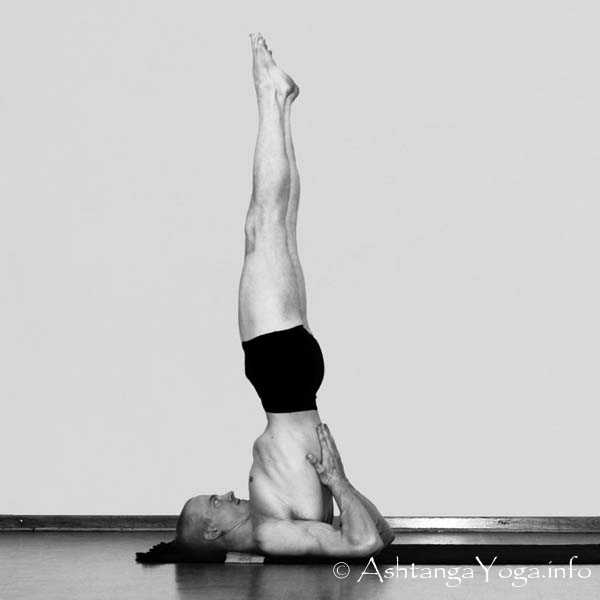 |
| Arjuna in Shoulderstand |
For all of you who expressed concern, thank you, I did indeed check with doctors and teachers, I am fine, and this book has been extraordinary helpful.
Thanks to David Garrigues, Joy Marzec, and Martina Jerrant for pointing me in the direction of this work.
The original, first book: Mind Over Back Pain:
Hi Claudia. The timing of all this is interesting for me. I occasionally suffer from spasms in my neck, and I've long know they were triggered by a combo of too much computer time and stress. I recently had a massage, and the therapist opened up to me (probably because I started off talking about yoga). She said that our stress follows familiar pathways, which is why my pain is always in the same spot. She also told me something interesting -- that our bodies' tightness is often locked emotional pain that we never got out. This book seems to confirm what she was saying, and I must admit I'm not surprised.
ReplyDeleteThanks for sharing it!
Hm, very interesting Brigitte. I absolutely believe that. Once I heard someone say that there are "issues in the tissues" :-)
Deletewhile i believe in this theory, i have also suffered from structural (disc related) back pain, and this does need to be taken seriously. Not that addressing tension and anxiety doesn't help with some of the overlay of muscle issues. It's possible to have both going on. sometimes it's hard to sort it all out, but I believe in respecting both.....but interestingly a top orthopedist told me to just keep moving in the face of disc damage too--no physical therapy, not vigorous exercise, but walk and move.
ReplyDeleteyes I would say, of course! I agree completely. And very intresting what the orthopedist told you in spite of that.
DeleteHoward Stern is a HUGE proponent of Dr. Sarno's. For over 20 years Howard has promoted his work. He gives Dr. Sarno credit for curing his ocd. just an fyi.
ReplyDeleteJames mentioned that Hower Stern is a fan, but I had not idea that he says he cured his ocd through it... that is very cool that he could transfer the message to another issue!
Delete